Neuroscience at HOSS
Scroll down to find information for:
EEG (Electroencephalography)
EEG Teaching
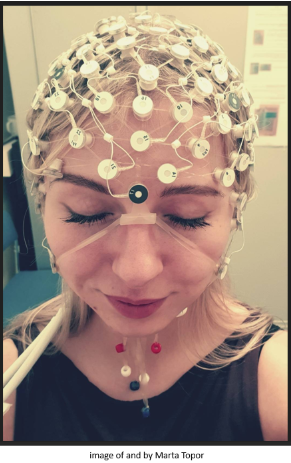
We use the Geodesic nets for teaching and demonstration purposes. Our lab has an electrically shielded and soundproofed room where we can record brain activity.
EEG Research
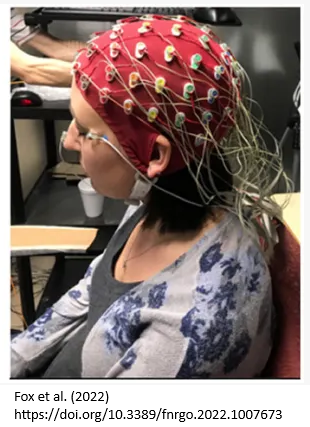
For research, we are soon going to use the BioSemi 64 channel system with active electrodes.
To design and plan an EEG study
- Knowledge of Python and/or Matlab will be necessary for analysing the data. Some self-learning resources can be found here - Fieldtrip Toolbox, MNE Python
- Design your experiment in PsychoPy
- Pilot your experiment
- You will need to have an approval from Etikprövningsmyndigheten.
If you have questions about setting up your first EEG study, the HOSS Lab members who can help are Carine Signoret and Marta Topor.
Open Science Practices for EEG Research
Open EEG Data
You can access many already available open EEG datasets from Open Neuro.
If you plan to share your own datasets:
- make sure that participants have given consent to having their EEG recording shared openly
- make sure that the dataset follows the Brain Imaging Data Stracture (BIDS)
- follow the COBIDAS best practices for data analysis and sharing
Preregistration and registered reports
The OSF has recently implemented a specific preregistration form for EEG and ERP studies.
You can also preregister your study on the OSF and follow the standard preregistration form or upload a document with research plans, if the avaiable template does not meet your needs.
You can submit a registered report to a number of neuroscience journals, for example, Cortex, European Journal of Neuroscience or Journal of Cognitive Neuroscience. You can check the full list of journals on the OSF.
EEG manuscritpts are also welcome at PCI Registered Reports.
MEG (Magnetoencephalography)
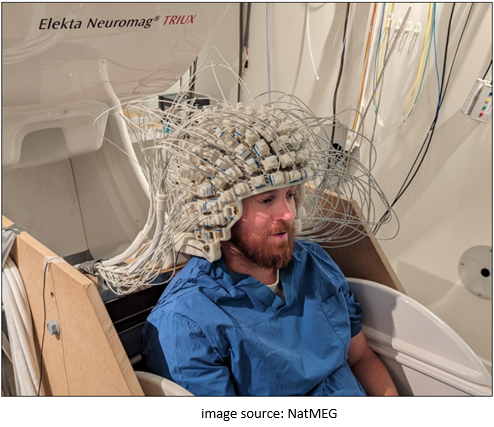
At HOSS, we do not have our own MEG system, but we collaborate with NatMEG at Karolinska Institutet to arrange data collection with their highly innovative OPM-based system.
To design and plan a study at NatMEG
- Make sure that you have sufficient budget for an MEG study (one hour of testing costs around 3k SEK).
- Knowledge of Python and/or Matlab will be necessary for analysing the data (NatMEG organises a great PhD course on data analysis during the spring term).
- Design your experiment in PsychoPy or Presentation (NatMEG offers support with presentation coding: https://k-cir.github.io/cir-wiki/natmeg/presentation/01_Presentation/).
- You will need to arrange a piloting and set up time with the team at NatMEG. You can also consider applying for a time grant to cover the costs of piloting (https://natmeg.se/services/time-grants.html).
- You will need to complete the MEG driving license course (regularly offered).
- You will need to have an approval from Etikprövningsmyndigheten.
- All data collection sessions require two researchers to be present. NatMEG offers measurement assistance and full recording service for an added cost.
If you have questions about setting up your first MEG study, the HOSS Lab members who can help are Carine Signoret and Marta Topor. You can also contact Christoph at NatMEG directly christoph@natmeg.se.
Open Science Practices for MEG Research
Open MEG Data
You can access many already available open MEG datasets from Open Neuro.
If you plan to share your own datasets:
- make sure that participants have given consent to having their MEG recording shared openly
- make sure that the dataset follows the Brain Imaging Data Stracture (BIDS)
- follow the COBIDAS best practices for data analysis and sharing
Preregistration and registered reports
You can preregister your study on the OSF and follow the standard preregistration form or upload a document with research plans, if the avaiable templates do not meet your needs. To guide your preregistration, follow best practices described in the COBIDAS preprint.
You can submit a registered report to a number of neuroscience journals, for example, Cortex, European Journal of Neuroscience or Journal of Cognitive Neuroscience. You can check the full list of journals on the OSF.
MEG manuscripts are also welcome at PCI Registered Reports.
fNIRS (Functional Near-Infrared Spectroscopy)
We are in the process of acquiring an fNIRS system. Pictures and information will be uploaded soon :)
Open Science Practices for fNIRS Research
Open fNIRS Data
You can access many already available open fNIRS datasets from Open Neuro.
If you plan to share your own datasets:
- make sure that participants have given consent to having their fNIRS recording shared openly
- make sure that the dataset follows the Brain Imaging Data Stracture (BIDS)
Preregistration and registered reports
You can preregister your study on the OSF and follow the standard preregistration form or upload a document with research plans, if the avaiable templates do not meet your needs. To guide your preregistration, follow best practices described in Yücel et al., 2021.
Further details on methodological quality can be found in this collection of papers.
You can submit a registered report to a number of neuroscience journals, for example, Cortex, European Journal of Neuroscience or Journal of Cognitive Neuroscience. You can check the full list of journals here the OSF.
fNIRS manuscripts are also welcome at PCI Registered Reports.
fMRI (Functional Magnetic Resonance Imaging)
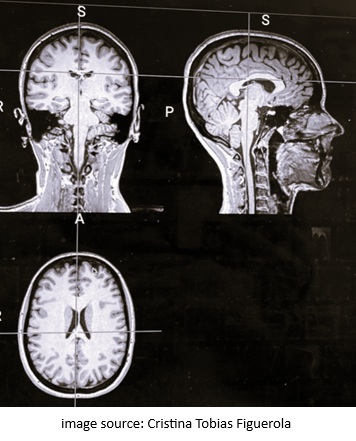
We do not have our own scanner at HOSS, but it’s possible to collaborate with LiU’s Centre for Medical Imaging and Visualisation (CMIV) or the national infrastructure Stockholm University Brain Imaging Centre (SUBIC).
To design and plan an fMRI study
- Make sure that you have sufficient budget for an fMRI study
- Some knowledge of Matlab or R will be necessary for analysing the data
- Design your experiment in PsychoPy or Presentation
- You will need to arrange a piloting and set up time with the team at the scanner.
- You will need to complete the MR driving license course (regularly offered).
- You will need to have an approval from Etikprövningsmyndigheten.
- All data collection sessions require two researchers to be present.
If you have questions about setting up your first fMRI study, the HOSS Lab member who can help is Mikael Skagenholt.
Open Science Practices for fMRI Research
Open fMRI Data
You can access many already available open fMRI datasets from Open Neuro.
If you plan to share your own datasets:
- make sure that participants have given consent to having their fMRI recording shared openly
- make sure that the dataset follows the Brain Imaging Data Stracture (BIDS)
Preregistration and registered reports
You can preregister your study on the OSF and follow the standard preregistration form or upload a document with research plans, if the avaiable templates do not meet your needs. To guide your preregistration, follow this preregistration template Frauke et al., 2021.
Further details on methodological quality can be found in this reporting template.
You can submit a registered report to a number of neuroscience journals, for example, Cortex, European Journal of Neuroscience or Journal of Cognitive Neuroscience. You can check the full list of journals on the OSF.
fMRI manuscripts are also welcome at PCI Registered Reports.
Examples of approved Stage 1 Registered Reports from LiU:
- The effect of signal quality on speech and sign language perception. Cristina Tobias Figuerola, Emil Holmer, Josefine Andin, Carine Signoret. Journal of Cognitive Neuroscience.
Examples of published Stage 2 Registered Reports from LiU
- Arithmetic in the signing brain: Differences and similarities in arithmetic processing between deaf signers and hearing non-signers Josefine Andin, Åsa Elwér, Elina Mäki-Torkko, Journal of Neuroscience Research (corresponding Stage 1)